

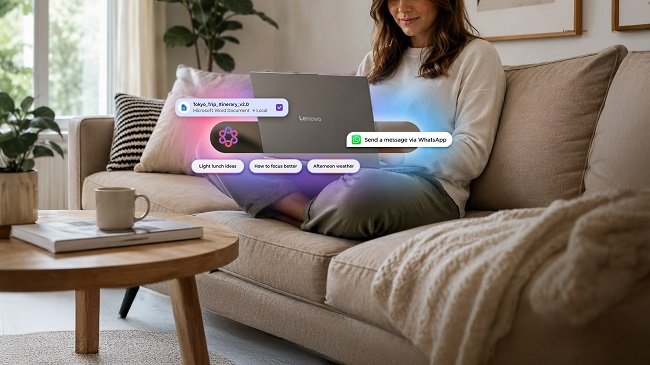
Lenovo is expanding the reach of Lenovo Qira, its personal artificial intelligence experience designed to work across compatible Lenovo and Motorola devices, bringing the technology to a broader range of products, applications and everyday digital experiences.
First introduced at the beginning of 2026, Lenovo Qira was designed around the idea of having one personal AI experience that can follow users across their devices. At Mobile World Congress in March, Lenovo announced the initial rollout across more than 20 Lenovo devices.
The company has now announced the next phase of that expansion at Lenovo Innovation World during IFA 2026, extending Lenovo Qira to additional hardware configurations, Motorola smartphones, wearables and a growing selection of connected applications and services.
Support Expands to 16GB PCs
One of the latest developments is broader support for eligible PCs equipped with 16GB of memory. The expansion means Lenovo Qira will no longer be limited to higher-memory configurations, making the personal AI experience available to a wider range of compatible PC users.
Lenovo is also continuing to optimize local AI models, strengthening the on-device AI foundation behind Lenovo Qira. Eligible users can download Lenovo Qira through Lenovo’s website.
The company said Lenovo Qira has shipped on millions of devices globally during the past five months, covering selected ThinkPad, Yoga, Legion and IdeaPad PCs, Lenovo tablets and Motorola edge smartphones.
The experience is currently available across six languages, with additional languages planned. Lenovo expects Lenovo Qira to reach more device families before the end of 2026, including products in the wearables category.
Motorola Devices Join the Expansion
The expansion also extends Lenovo Qira to eligible Motorola devices as they receive the Android 17 upgrade in the coming months.
The rollout will take place gradually, with availability depending on the specific device and market. On supported Motorola devices that currently feature moto ai, the Android 17 upgrade will introduce Motorola Qira, bringing a new generation of AI capabilities to Motorola users.
The strategy is designed to connect the Lenovo and Motorola ecosystems while allowing users to interact with their personal AI across different types of devices.
Lenovo Qira Comes to moto watch ultra
Lenovo Qira is also moving beyond PCs, tablets and smartphones with its arrival on the moto watch ultra, making it the first wearable to support Motorola Qira.
Users will be able to raise their wrist or say “Hey Qira” to ask general questions or retrieve information using Lenovo Qira’s cross-device knowledge.
Rather than reproducing exactly the same interface across every screen, Lenovo’s approach is to allow each device to perform the functions for which it is best suited while maintaining a consistent personal AI experience.
Dan Dery, Vice President of AI Ecosystem at Lenovo, said personal AI should move beyond being another application that waits for a prompt. He described Lenovo’s vision as an AI experience capable of understanding what matters to users, moving with them across devices and helping coordinate actions across the agents, applications and services they choose.
According to Dery, the latest evolution of Lenovo Qira is intended to bring that vision closer to reality through intelligence built into devices and designed around the individual, while maintaining privacy, choice and user control.
Connecting AI With Everyday Applications
Lenovo is also expanding Lenovo Qira’s ability to help users take action through everyday applications and services.
Through Lenovo’s new collaboration with Workato, Lenovo Qira can connect with supported services including Gmail, Google Calendar, Google Contacts, Slack, Outlook Mail and Outlook Calendar.
The integration is designed to allow users to complete actions through natural-language requests rather than navigating separately through multiple applications.
This approach creates a more direct transition from asking for information to taking action, while keeping user permission and control at the center of the experience.
For example, when a calendar event changes or an important update arrives through email or a group conversation, users can access the relevant information through Lenovo Qira instead of manually searching through individual applications.
Catch Me Up Simplifies Information Overload
Lenovo said users have increasingly gravitated toward features designed to reduce the amount of information they need to process themselves since Lenovo Qira was introduced in March.
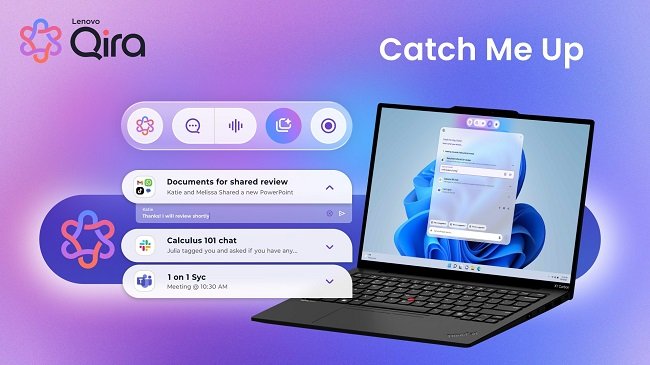
Among these features is Catch Me Up, which provides faster summaries than before and is designed to help users quickly understand important updates across their connected digital experiences.
The feature supports Lenovo’s broader strategy of positioning Lenovo Qira as a personal AI layer capable of bringing together information from multiple applications and devices.
Notion and Perplexity Expand the AI Ecosystem
Lenovo Qira is also adding a partnership with Notion while expanding its integration with Perplexity.
Through the Notion connection, users can link their accounts to access and edit information from their projects directly through Lenovo Qira. This can support activities such as working on moodboards and documents without requiring users to repeatedly switch between applications or devices.
The expanded Perplexity integration is designed to support deeper research and provide visual references based on users’ interests and goals.
Together, these integrations extend Lenovo Qira beyond a standalone AI interface and into a broader environment where users can access information, conduct research and work with content across connected services.
One AI Experience Across the Device Ecosystem
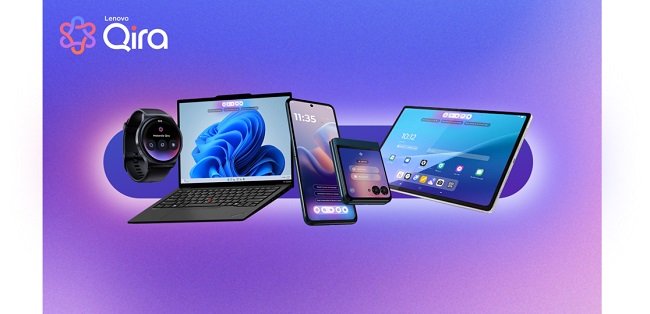
The latest expansion reflects Lenovo’s effort to develop a personal AI experience that can operate across multiple categories of hardware and software.
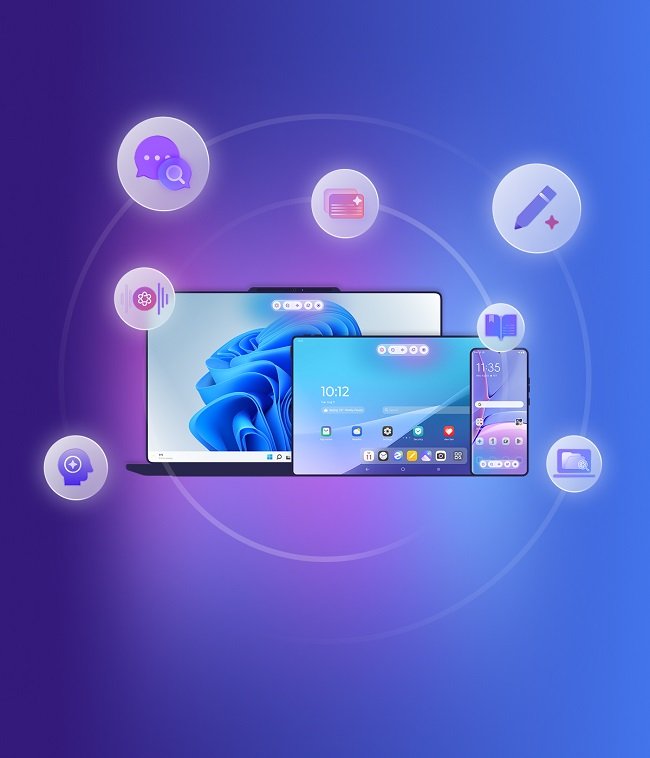
From 16GB PCs and Lenovo tablets to Motorola smartphones and the moto watch ultra, Lenovo Qira is being positioned as a continuous AI experience that can accompany users as they move between devices.
The addition of Gmail, Google Calendar, Google Contacts, Slack, Outlook, Notion and Perplexity further expands the range of information and tasks that users can access through the platform.
Lenovo expects the ecosystem to continue expanding through the end of 2026 as additional device families, languages, applications and connected experiences become available.
Availability and Compatibility
The availability, timing and user experience of the features presented at IFA 2026 may differ depending on the device, market, configuration and platform.
Some capabilities may require software updates, user permissions, supported applications or services, account sign-in, internet connectivity, or specific hardware and software configurations.
Partner integrations and connected application functionality may also vary according to market, service and account type.
Register to our mailing list to receive the latest news
Also follow us on the technology portal and its news in Egypt