

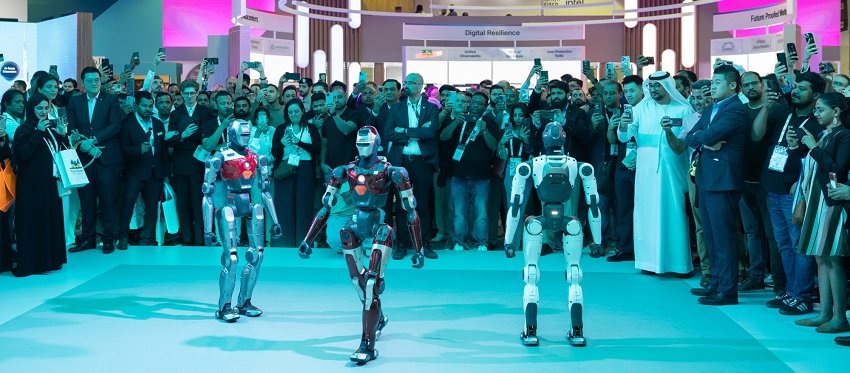
Dubai is preparing to host a major showcase of humanoid robotics and embodied artificial intelligence as GITEX World RobotiX 2026 makes its debut during the 46th edition of GITEX GLOBAL, bringing together international robotics manufacturers, AI developers, and technology innovators.
Taking place from December 8–11, 2026, at the Dubai Exhibition Centre in Expo City Dubai, the new event will highlight how Physical AI is moving beyond experimental demonstrations to practical applications across manufacturing, logistics, healthcare, hospitality, public services, and smart infrastructure.
From humanoid robots performing industrial tasks and multilingual robotic receptionists to wearable exoskeletons, intelligent robotic dinosaurs, and advanced AI computing platforms, the exhibition will present an extensive range of technologies designed to interact with the physical world.
The launch comes amid rapid growth in the global humanoid robotics industry. According to Counterpoint Research, worldwide humanoid robot shipments surpassed 22,000 units during the first half of 2026, representing an increase of nearly 300% year over year. Shipments are projected to exceed 50,000 units by the end of 2026.
The event will also support Dubai’s wider robotics ambitions, as the emirate advances its Robotics and Automation Program, which aims to deploy 200,000 robots over a ten-year period ending in 2032.
GITEX World RobotiX 2026 Showcases the Future of Physical AI
The launch of GITEX World RobotiX marks an expansion of GITEX GLOBAL’s focus on artificial intelligence, introducing a dedicated platform for technologies that combine intelligent software with robotic hardware.
Unlike conventional AI systems that primarily process information, generate content, or support digital decision-making, Physical AI enables machines to perceive their surroundings, interpret information, plan actions, and interact directly with real-world environments.
Embodied AI systems integrate artificial intelligence models with sensors, mechanical components, robotics software, and motion-control technologies, allowing machines to undertake tasks that require physical interaction.
These capabilities are increasingly relevant to industrial facilities, warehouses, hospitals, hospitality businesses, and public infrastructure operators seeking more adaptable automation solutions.
GITEX World RobotiX will bring together companies working across the robotics ecosystem, from humanoid manufacturers and robotic systems integrators to developers of AI computing hardware, simulation platforms, and autonomous control technologies.
Visitors will have opportunities to experience live demonstrations and explore how advanced robots could operate alongside human workers in commercial and industrial settings.
The exhibition will run alongside GITEX GLOBAL’s main technology showcase, which opens on December 8 following the GITEX Summit on December 7 at Dubai World Trade Centre.

Global Humanoid Robot Shipments Surge Nearly 300%
The debut of GITEX World RobotiX coincides with accelerating commercial interest in humanoid robots worldwide.
According to Counterpoint Research, more than 22,000 humanoid robots were shipped globally during the first six months of 2026, reflecting nearly 300% annual growth.
The research firm expects worldwide shipments to surpass 50,000 units by the end of the year, indicating a substantial expansion in demand for machines designed to operate in human environments.
This growth reflects increasing investment in robotic systems capable of performing industrial tasks, supporting service operations, and interacting with people.
The development of more advanced AI models, improved motion-control systems, and increasingly capable computing platforms is contributing to the commercial evolution of the sector.
However, the transition from research prototypes to widespread deployment remains dependent on operational reliability, safety, cost efficiency, and integration with existing business systems.
Against this backdrop, GITEX World RobotiX will provide an opportunity for manufacturers to demonstrate the progress of their technologies and introduce solutions targeting real-world applications.
Dubai Targets 200,000 Robots Through Its Automation Program
Dubai is pursuing its own ambitions in robotics and automation through an initiative designed to accelerate the adoption of intelligent machines.
The Dubai Robotics and Automation Program targets the deployment of 200,000 robots over ten years through 2032, supporting the emirate’s broader strategy to develop advanced technology capabilities.
The initiative reflects Dubai’s interest in integrating robotics into economic and service sectors while encouraging innovation and technological development.
By hosting GITEX World RobotiX, the city is positioning itself as a meeting point for global robotics manufacturers, AI researchers, technology providers, investors, and organisations exploring automation.
The exhibition will also offer international companies opportunities to connect with regional customers and partners interested in deploying robotics solutions.
As robotic technologies become increasingly sophisticated, events bringing together hardware developers and AI software companies are becoming more important for advancing commercial adoption.
Unitree Leads Global Robotics Participation
Chinese robotics manufacturer Unitree, one of the world’s major humanoid robot producers, will be among the leading participants at GITEX World RobotiX 2026.
According to Counterpoint Research, Unitree accounted for approximately 31% of global humanoid robot shipments during the first half of 2026, highlighting its position within the expanding market.
The company will be joined by several established and emerging robotics innovators.
UBTECH, whose humanoid robots are deployed in automotive manufacturing facilities and undergoing testing by Airbus, will present its capabilities in industrial robotics.
AiMOGA, the embodied AI robotics brand associated with Chinese automotive manufacturer Chery Auto, will also participate.
Other exhibitors include DEEP Robotics, known for developing advanced quadruped robots, and UAE-based Micropolis Robotics, which supplies autonomous patrol robots used by Dubai Police.
These companies represent different segments of the robotics market, from humanoid systems designed for industrial work to autonomous machines supporting security and public services.
Their participation reflects the increasing diversity of robotics applications and the growing convergence of AI technology, autonomous systems, and industrial automation.
Mangobot Demonstrates a Robotic Workforce in Action
UAE-based Mangobot, a robotics solutions company specialising in deploying and integrating intelligent machines, will introduce a robotic workforce designed to demonstrate how autonomous technologies can support practical business operations.
Its showcase will feature autonomous general-purpose robots, robotic patrol systems, multilingual reception assistants, and live robotic performances.
Visitors will also be able to experience wearable exoskeleton technology, providing a firsthand introduction to systems designed to support or enhance certain physical movements.
The company aims to create an interactive exhibition environment that illustrates how humans and robots could collaborate in everyday professional settings.
Mazen El-Kurdi, Chief Technology Officer at Mangobot, explained that the demonstrations are intended to move beyond traditional product presentations.
Rather than simply observing robots, visitors will be invited to experience what working alongside intelligent machines could look like.
This approach reflects the growing emphasis on practical robotics deployment, where successful adoption depends not only on technical capabilities but also on how effectively machines can operate within existing workflows.
Lumos Robotics Unveils MOS 2 AI Worker in the Middle East
Chinese embodied intelligence company Lumos Robotics will introduce its MOS 2 robotic platform to the Middle East for the first time during GITEX World RobotiX.
Designed as a wheeled AI Worker, MOS 2 features two robotic arms and is intended to undertake physical tasks within industrial environments.
According to the company, the robot can handle payloads of up to 50 kilograms and operate for more than eight hours.
Its design targets applications requiring material handling, physical manipulation, and interaction with industrial equipment.
The introduction of MOS 2 reflects the development of robotic systems that combine autonomous navigation with manipulation capabilities.
Unlike fixed industrial robots operating within highly structured environments, mobile robotic workers are being developed to perform a wider range of activities across changing workspaces.
These capabilities could offer manufacturers additional flexibility when integrating automation into operational processes.
MOS Robots Record 1,000 Hours of Factory Operation
Lumos Robotics also highlighted the operating record of its first-generation MOS robots.
According to the company, the machines completed more than 1,000 hours of continuous operation without failures at Mitsubishi Electric’s Changshu factory in China.
During this period, the robots reportedly performed tasks involving material handling, quality inspection, and screwdriving.
The company presents this experience as evidence of its focus on developing robotic systems capable of undertaking useful work reliably in real industrial settings.
The reported performance illustrates the importance manufacturers place on durability and operational consistency as robots transition from demonstrations to production environments.
While robotics capabilities can be impressive in controlled settings, sustained deployment requires machines to maintain reliable performance throughout extended operating periods.
The operational results cited by Lumos Robotics are company-reported figures.
NIX S3 Demonstrates Advanced Robotic Motion
Alongside MOS 2, Lumos Robotics will showcase its NIX S3 robot through a live dance performance designed to highlight its motion-control capabilities.
The robot features 21 degrees of freedom, high-torque joints, and advanced movement capabilities that support dynamic motion and agility.
The demonstration will illustrate how improvements in mechanical design and control systems are allowing robots to execute increasingly complex movements.
Such capabilities are relevant to the broader development of humanoid and mobile robotics, where balance, coordinated movement, and mechanical responsiveness are essential.
Cecile Wei, Public Relations Director at Lumos Robotics, said the company’s demonstrations are designed to communicate a broader principle behind its technologies.
She emphasised that robots must deliver more than movement alone and should be capable of performing useful tasks reliably in real operating environments.
The company’s participation therefore combines visually engaging demonstrations with examples of industrial applications.
Lootah Robotics Presents an Integrated Robotics Ecosystem
UAE-based Lootah Robotics will showcase a diverse range of robotic technologies from several international manufacturers.
The company’s exhibition will include humanoid robots, quadruped systems, service robots, cleaning robots, and telepresence platforms.
Participating manufacturers represented through the showcase include Unitree, AGIBOT, Pudu Robotics, UBTECH, and EngineAI.
Lootah Robotics will focus on demonstrating how different robotic systems can be integrated into a coordinated operational environment.
This approach addresses a growing challenge for organisations adopting robotics: managing multiple machines designed for different tasks without creating fragmented systems.
Hazem Ghazal, General Manager of Lootah Robotics, said the company’s strategy goes beyond supplying individual robotic products.
He explained that Lootah Robotics is developing an integrated ecosystem that allows organisations to select machines according to their operational requirements while maintaining centralised monitoring and control.
This model reflects the increasing importance of robotics integration platforms capable of connecting different technologies within a single management environment.
Embodied AI Expands Into Homes and Consumer Services
The advancement of embodied artificial intelligence is creating new opportunities for robots to interact more naturally with people.
While industrial automation remains a major market, robotics companies are increasingly exploring applications in consumer services, education, entertainment, hospitality, and domestic environments.
These developments rely on bringing AI models into physical hardware systems capable of sensing their surroundings and responding through movement and interaction.
As technologies mature, robots could support a wider range of tasks that require communication, mobility, and physical engagement.
GITEX World RobotiX will highlight this transition through demonstrations of robots designed for consumer interaction and public-facing applications.
The exhibition will also explore how robotics design can influence user acceptance, particularly when machines are intended to operate in homes or environments where direct interaction with people is common.
Light Origins Debuts Its Bunny-Shaped Household Robot
Chinese robotics developer Light Origins will introduce its bunny-shaped robot to the public for the first time during GITEX World RobotiX 2026.
The company specialises in humanoid robots and intelligent robotic systems and will demonstrate the new device through simulated household scenarios.
Visitors will have opportunities to interact directly with the robot and explore its potential domestic applications.
The product’s bunny-inspired design reflects efforts to make intelligent robots more approachable for consumer environments.
Tingxiang Fan, Co-founder and Chief Technology Officer at Light Origins, expressed confidence in the product’s readiness for home use.
According to Fan, the company believes its bunny-shaped robot is ready to enter consumers’ homes.
The demonstration will provide an opportunity to examine how consumer-oriented robots combine physical design, intelligent interaction, and movement capabilities.
Raydiculous Introduces Arabic-Speaking TP01 Humanoid
Robotics innovator Raydiculous, associated with the Chengdu Humanoid Robot Innovation Centre, will make its Middle East debut with two robotic technologies.
The first is TP01, a humanoid robot developed for commercial interaction and public-service environments.
The robot can communicate in Arabic and English, making it particularly relevant to multilingual markets across the Middle East.
TP01 can also perform synchronised movements, demonstrating its ability to combine physical actions with interactive functions.
The capacity to communicate in Arabic represents an important feature for service-oriented robots targeting regional markets.
Hospitality providers, retailers, and public-service organisations increasingly require technology capable of interacting with users in their preferred languages.
By incorporating multilingual communication into humanoid robotics, developers are exploring ways to improve accessibility and usability in customer-facing environments.
DINOBOT Brings an Intelligent Walking Dinosaur to Dubai
Raydiculous will also showcase DINOBOT, an intelligent bionic dinosaur capable of walking on two legs.
The company describes DINOBOT as the world’s first intelligent bipedal walking bionic dinosaur, a claim attributed to the developer.
During the exhibition, the robot will demonstrate realistic movement and interactive capabilities.
Its design combines biomimetic robotics with technologies intended for entertainment, educational experiences, and audience engagement.
The demonstration will illustrate how physical AI can be applied beyond traditional humanoid forms to robotic systems inspired by animals and other living organisms.
Sandy Liu, Overseas Sales Manager at the Chengdu Humanoid Robot Innovation Centre, said the company’s solutions combine walking, interaction, performance, and education.
According to Liu, these capabilities help transform Physical AI into a practical and visible technology that businesses can use.
The company’s participation will therefore highlight both commercial service robotics and interactive applications designed to attract public attention.
Besomi Launches Six Robots Under the Besomi Rangers Brand
UAE-based robotics education and technology company Besomi will introduce a collection of six humanoid and mobile robots known as the Besomi Rangers.
The showcase is designed to demonstrate robotic capabilities while encouraging the development of engineering and AI skills among students, young professionals, and innovators.
Besomi will collaborate with several technology companies at its exhibition stand, including Unitree, Seeed Studio, Arduino, and Qualcomm.
The company will also display Unitree’s latest humanoid robot, giving visitors an opportunity to explore developments from one of the industry’s major manufacturers.
Besomi’s participation highlights the importance of connecting robotics innovation with practical education and skills development.
As the industry expands, the ability to train engineers and developers in AI, embedded computing, programming, and robotic systems integration is becoming increasingly important.
The company’s approach aims to encourage future innovators to move beyond observing robotics technologies and develop the skills required to build them.
Robotics & AI Lab Offers Hands-On Engineering Training
Besomi will operate a live Robotics & AI Lab, allowing visitors to explore how robots are designed, programmed, tested, and trained.
The laboratory will include practical engineering activities using the Arduino VENTUNO platform, developed in collaboration with Qualcomm.
Participants will be introduced to technologies and development processes involved in building robotics and AI applications.
The initiative is designed to connect theoretical understanding with hands-on experimentation, creating opportunities for engineers to apply their knowledge directly.
Mohammad Hani, CEO of Besomi Robotics & AI, said the company wants young engineers and innovators to question how robotics technologies work and then use that knowledge to build future systems in the UAE.
He highlighted the importance of showcasing the latest Unitree humanoid while providing practical training through Arduino and Qualcomm technologies.
According to Hani, these experiences can help developers transform their ideas into functioning robotics and AI applications.
He also welcomed Seeed Studio’s participation, describing it as part of the company’s efforts to strengthen engineering capabilities and practical technology education.
JWIPC Launches NVIDIA Thor-Powered Robotics Controllers
Chinese AI hardware and industrial computing company JWIPC will introduce advanced robotic controllers built around NVIDIA’s Thor computing module.
According to JWIPC, the module can deliver up to 2,070 TFLOPS of FP4 computing performance, providing substantial processing capabilities for complex robotics applications.
The controllers are designed for humanoid robots, robotic arms, and autonomous mobile robots.
Their purpose is to support AI inference, real-time decision-making, and the processing demands associated with sophisticated robotic systems.
Advanced robotics requires the ability to interpret sensor information, plan actions, and control physical movement with minimal delay.
By integrating powerful computing hardware directly into robotic platforms, manufacturers aim to support faster local decision-making without depending entirely on remote processing infrastructure.
The Thor-based controllers reflect the growing importance of high-performance edge computing in the development of embodied intelligence.
NVIDIA Thor Supports Real-Time Robotic Intelligence
JWIPC’s showcase will demonstrate how advanced computing systems can function as the processing foundation of autonomous machines.
Nick Zhang, Regional Sales Manager at JWIPC, described NVIDIA Thor as a high-performance edge computing system capable of supporting embodied AI applications.
According to Zhang, the module enables multimodal AI models to run locally while integrating sensor fusion, task planning, and motion control measured in milliseconds.
These capabilities are important for robots operating in dynamic environments, where rapid interpretation of information can be essential for reliable movement and interaction.
Multimodal models can process different forms of information, including inputs from sensors and other connected systems.
Sensor fusion helps combine these inputs into a more complete representation of the environment.
When integrated with planning and motion-control technologies, these capabilities support robots in translating information into physical actions.
JWIPC’s controllers are intended to provide the computing resources required for such operations across different robotic platforms.
Songying Technology Showcases ORCA Robotics Development Platforms
Software developer Songying Technology will demonstrate its ORCA OS and ORCA Lab solutions during GITEX World RobotiX.
The platforms are designed to connect key stages of robotics development within a single environment.
Their capabilities include simulation, synthetic data generation, AI model training, validation, and deployment.
This integrated approach aims to simplify the development process for companies building intelligent robotic systems.
Simulation environments allow developers to test robotic behaviour under different conditions before deploying machines in physical settings.
Synthetic data can support AI model training, while validation tools help assess performance during development.
By bringing these functions together, Songying Technology aims to create a more connected workflow for robotics engineers and AI developers.
Such platforms are becoming increasingly important as the complexity of embodied AI systems grows and developers seek more efficient methods of preparing robots for real-world applications.
Vecow Expands Its Edge AI Presence in the UAE
Taiwan-based embedded computing specialist Vecow will present advanced industrial Edge AI and robotics platforms designed for demanding operational environments.
The company will showcase rugged computing solutions incorporating technologies from NVIDIA, Intel, AMD, Qualcomm, and NXP.
These platforms are intended to provide processing capabilities for AI-enabled industrial and robotic applications where reliability and local computation are essential.
Vecow will also officially introduce its dedicated UAE team, supporting the company’s efforts to expand regional deployments.
The move is designed to accelerate the implementation of mission-critical computing and robotics solutions across regional markets.
The company’s participation reflects increasing demand for industrial-grade computing infrastructure capable of supporting intelligent machines in challenging environments.
As robotics becomes more widely adopted, reliable embedded computing platforms are expected to remain a key component of autonomous systems.
Physical AI Creates New Opportunities Across Major Industries
The technologies featured at GITEX World RobotiX illustrate the expanding range of sectors exploring the practical use of embodied artificial intelligence.
In manufacturing, robots are being developed to handle materials, inspect components, and assist with repetitive production tasks.
Logistics operators are exploring autonomous mobile systems capable of supporting warehouse operations and internal transportation.
Healthcare providers are examining potential applications for intelligent assistance and automated operational processes.
Hospitality businesses and public-service organisations are also interested in multilingual robotic assistants that can interact directly with customers and visitors.
Smart infrastructure operators are investigating autonomous patrol systems and technologies that can support monitoring and other operational activities.
Despite these opportunities, successful deployment requires careful consideration of safety, maintenance, integration costs, operational reliability, and human oversight.
The exhibition will provide manufacturers and potential customers with a forum for assessing how these technologies could be incorporated into existing operations.
GITEX GLOBAL 2026 Brings Together More Than 6,000 Exhibitors
The 46th edition of GITEX GLOBAL, organised by inD, will begin with the GITEX Summit at Dubai World Trade Centre on December 7, 2026.
The main four-day exhibition will then take place from December 8–11 at Dubai Exhibition Centre in Expo City Dubai.
GITEX World RobotiX will form part of the wider exhibition programme, alongside other technology-focused showcases.
The event will also take place alongside Expand North Star, the startup and investor gathering that connects entrepreneurs, emerging companies, venture capital firms, and technology investors.
According to the organisers, the combined events will bring together more than 6,000 enterprise and startup exhibitors.
Tens of thousands of government representatives, business leaders, C-suite executives, investors, and technology buyers from approximately 180 countries are expected to participate.
The gathering is intended to provide opportunities for international collaboration, investment, business development, and the commercial introduction of advanced technologies.
Dubai Positions Itself at the Centre of the Robotics Revolution
The introduction of GITEX World RobotiX reflects the growing importance of robotics within the global artificial intelligence industry.
As machines become more capable of interpreting information and performing physical actions, the relationship between software intelligence and industrial hardware is evolving.
The exhibition will bring this transition into focus through demonstrations spanning humanoid robotics, industrial automation, multilingual assistance, consumer robots, educational systems, and high-performance AI computing.
It will also highlight the companies developing the infrastructure required to support autonomous machines, including advanced processors, robotics operating systems, and simulation platforms.
By combining international technology manufacturers with regional businesses, researchers, engineers, and investors, GITEX World RobotiX aims to accelerate collaboration and explore the commercial potential of Physical AI.
The event’s significance extends beyond showcasing futuristic machines. Its broader objective is to demonstrate how robotics can increasingly support useful activities within real operating environments.
With the global humanoid robotics market expanding rapidly and Dubai pursuing ambitious automation targets, GITEX World RobotiX 2026 is positioned to become an important platform for demonstrating how embodied AI could reshape industries and everyday experiences.
Further information is available through the official GITEX GLOBAL website and the GITEX World RobotiX event page.
Register to our mailing list to receive the latest news
Also follow us on the technology portal and its news in Egypt